


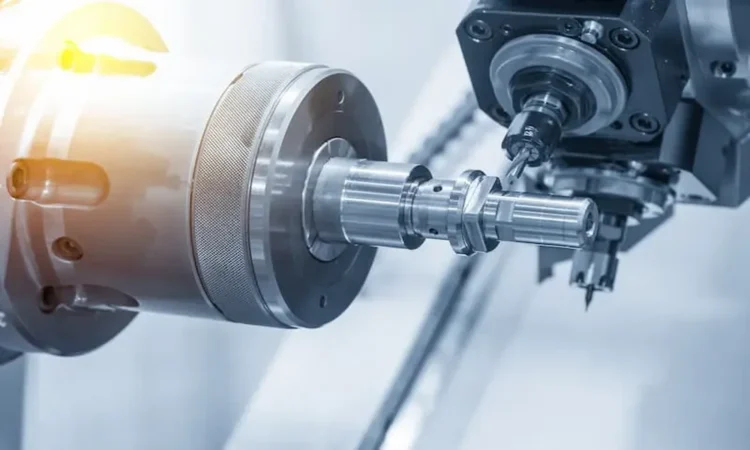

CNC turning is a machining process in which a workpiece rotates while a cutting tool moves along programmed paths to remove material and create the desired geometry. The machine used is a CNC lathe, which controls the position of the cutting tool with high precision under computer numerical control. The combination of rotation and controlled tool movement allows CNC turning to produce cylindrical, conical, and contoured forms with consistent accuracy across production runs of any size.
The process is distinct from milling, where the cutting tool rotates and the workpiece is held stationary. In turning, the dynamic relationship between a rotating workpiece and a controlled tool path is what generates the final shape. Modern CNC lathes often incorporate milling capability in a single machine, allowing both operations to be performed with a single setup in what is commonly called turn-mill or mill-turn machining.
Types of Parts Produced by CNC Turning
The defining characteristic of parts suited to CNC turning is rotational symmetry. Shafts, spindles, pins, bushings, threaded fasteners, nozzles, valve bodies, and bearing housings are all examples of components that have a geometric form based around an axis of rotation and are therefore efficiently produced by turning.
Threads are among the most commonly produced features in turned parts. Both external threads on bolts and studs and internal threads in nuts and housings are produced by turning operations, with the thread form cut by a dedicated threading tool following a programmed helix path. The precision and consistency of CNC-controlled thread cutting exceeds what is achievable by hand tapping or chasing, and it is particularly important for fine-pitch threads and threads in exotic materials.
Tapers, radii, chamfers, grooves, and undercuts are also standard features of CNC turned parts. Grooves for O-ring seating, snap ring retention, or hydraulic seal location are machined to precise widths and depths that determine how effectively the seal functions in service. Incorrect groove dimensions are a common cause of seal failure, and the precision of CNC turning makes dimensional compliance with seal manufacturer specifications reliable.
- Shafts, spindles, and pins , cylindrical forms with tight diameter tolerances
- Threaded fasteners and studs , external and internal threads in any pitch
- Bushings and bearing housings , precision bores for bearing location
- Valve bodies and nozzles , rotationally symmetric fluid-control components
- Grooved components , O-ring seats, snap ring grooves, and hydraulic seal locations
Materials Processed by CNC Turning
CNC turning is applicable to a wide range of materials. Steel alloys in various grades, stainless steels, aluminium alloys, brass, copper, titanium, and engineering plastics such as PEEK, nylon, and Delrin are all routinely machined by turning. The choice of cutting tool material, tool geometry, cutting speed, feed rate, and coolant is adapted to each material to achieve the desired surface finish and tool life.
Difficult-to-machine materials such as Inconel, Monel, and other nickel-based superalloys require specialist tooling and parameters but are processed by CNC turning for aerospace, oil and gas, and chemical process equipment applications where corrosion and temperature resistance are essential.
When CNC Turning Is the Right Choice
CNC turning is the appropriate process when the part has a form that is based on rotation around a central axis. For parts that are predominantly cylindrical with features on the outer or inner diameter, turning is the most efficient route to the finished dimension. Attempting to produce the same form by milling would require more machine time, more setups, and more material waste.
Volume is relevant to the choice of process but not determinative. CNC turning is equally viable for a single prototype and for a batch of thousands. The programming time for a turned part is recovered over the run, and for high-volume production, automatic bar feeders and multi-spindle arrangements reduce cycle times and labour requirements further. For prototype quantities, quick-change tooling and modern programming software reduce setup time sufficiently to make small runs economical.
Tolerance requirements are another factor in the decision to use CNC turning. Precision turned components routinely achieve tolerances of 0.01 mm and finer on diameter, and surface finishes suitable for bearing fits and hydraulic sealing are achievable with correct tooling and process parameters. Where these tolerances are required on a rotationally symmetric part, CNC turning is the standard method for achieving these reliably in production.
Quality and Inspection of CNC Turned Parts
Inspection of CNC turned parts covers dimensional checks on critical features, surface finish measurement, and material and hardness verification where specified. Coordinate measuring machines are used for complex parts or where full documentation of dimensional compliance is required. For production runs, statistical process control techniques allow the process to be monitored and adjusted before out-of-tolerance parts are produced, rather than after.
Traceability of material and processing records is important for components used in regulated industries such as aerospace, medical devices, and nuclear power. CNC turning operations in these sectors are subject to quality management systems such as AS9100 or ISO 13485 that govern how parts are processed and documented from raw material receipt to final inspection.
Surface Finishing Options After Turning
The surface condition of a CNC turned part after machining can be enhanced by secondary finishing processes depending on the requirements of the application. Ground finishes on diameter features improve surface roughness and dimensional accuracy beyond what is achievable by turning alone and are used for components requiring bearing fits or hydraulic sealing surfaces. These finishing capabilities are important for CNC auto parts manufacturers producing components that require precise tolerances and reliable performance.
Hard turning, using cubic boron nitride or ceramic cutting tools on hardened steel, produces surface finishes and dimensional accuracy that can substitute for grinding in many cases, reducing process steps and associated cost. The applicability of hard turning depends on the material hardness and the specific surface roughness requirements of the component.
Anodising, plating, phosphating, and painting are surface treatment processes applied to turned parts in aluminium, steel, or copper alloys to improve corrosion resistance, hardness, or appearance. The choice of finishing process depends on the service environment, the base material, and any dimensional changes introduced by the process that must be accounted for in the machining dimensions.